top of page

# Publications from the founders

The first in vivo proof that de novo designed binders work as therapeutics: AI-designed proteins that neutralised lethal three-finger toxins and protected animals from an otherwise fatal venom challenge. A demonstration that designed binders can hit a hard, medically urgent target and function in a living system. (with the Baker lab)

Designed protein inhibitors applied to an industrial bioprocessing problem, showing the platform's reach beyond therapeutics into industrial and food-tech applications.

Designed binders that block Gremlin-1 at a defined epitope, showing the platform's ability to engineer precise, mechanism-specific antagonism at pM affinity rather than undirected binding.
Science 2025
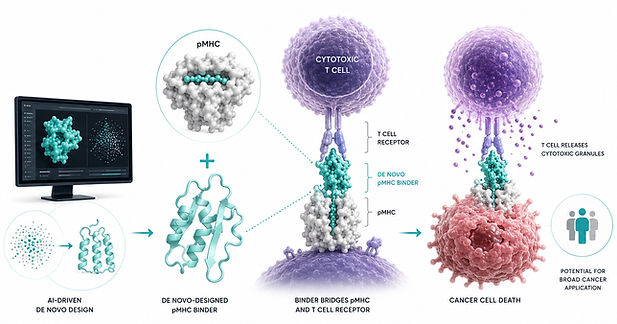
Designed binders that recognise peptide–MHC complexes and direct immune cells to kill cancer cells, tackling one of the hardest and most valuable target classes in immunotherapy. Evidence the platform reaches targets conventional discovery struggles to address.

A large-scale analysis of what actually predicts binder success, the kind of empirical, honest groundwork that lets us estimate the odds for a target before a campaign begins.
Nature Communications 2026

A method for designing high-affinity binders to difficult, hydrophilic β-strand target sites that defeat standard approaches. Binders against seven therapeutically relevant targets including KIT, PDGFRα, ALK-2 and ALK-3, reaching picomolar to nanomolar affinities, with high specificity even between closely related family members. (led by Baker lab)

A designed cyclic peptide agonist of MC4R, a GPCR, with a functional effect in vivo. Evidence the platform extends to peptide modalities, GPCR targets, and agonism, not just inhibitory binding. (led by Gubra)
bottom of page