Designing Impact
# Technology
Apex: one engine for designable biology
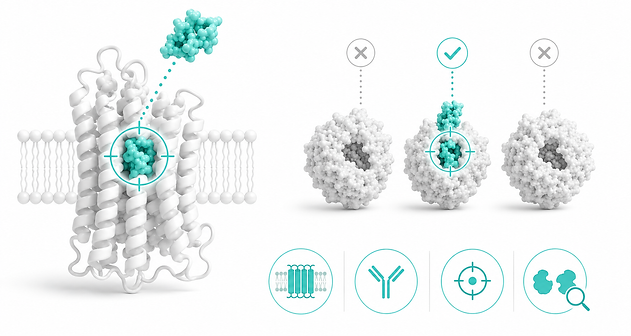
At the core of everything we make is Apex, our proprietary protein design platform. Apex takes a target and an epitope of interest and designs binders to it directly, specifying where each binder engages before anything reaches the bench. Rather than searching what nature or a library happens to contain, Apex builds the binder you need, in the modality your problem demands, optimised for specificity, function, and developability from the first design.
# Modalities
Designerbodies
Full-size IgG and fragment formats for therapeutic and reagent applications that call for a conventional antibody scaffold, effector function, or extended half-life. (In development & available through early partnerships)

Antibodies
Our de novo miniprotein binders, and the format we reach for most. Small (typically 6–15 kDa), exceptionally stable, and fast and cheap to produce in microbial systems, they excel where larger formats struggle: deep tissue penetration, demanding manufacturing, and rapid turnaround.
Nanobodies/VHHs
Single-domain antibody fragments that pair small size and robustness with a familiar, well-characterised scaffold, a strong fit when you want a format with an established development and regulatory track record.
Peptides
Short, designed binders for applications where a minimal footprint matters, such as targeting small or constrained sites, conjugation, or use as a detection and imaging tool.
# Features

Epitope-precise de novo design
Designs are expressed in cell-free or microbial systems and characterised experimentally for binding and, where needed, function, using only small quantities of target. And because we design to a defined epitope, we know each binder's predicted binding mode by construction, with no separate experimental structural campaign required.

Multi-parameter optimisation
Apex does not optimise for affinity alone. Candidates are scored and refined in silico across specificity, predicted function, stability, expression, and manufacturability together, so the binders that reach validation are already shaped for the path to a product. This collapses what is traditionally a long, sequential, and expensive optimisation cycle into the design step itself.
Multispecifics by design
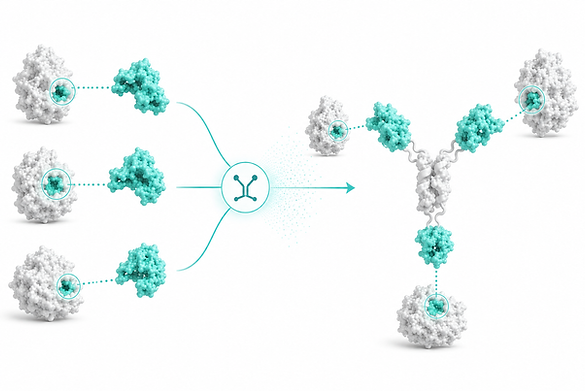
Because Apex designs to defined epitopes and learns what well-behaved proteins look like, it can propose and explore multispecific and multivalent architectures from validated binding domains, linking them while preserving each one's affinity and keeping the whole construct developable. Most multispecifics fail because they misfold, aggregate, or lose binding; designing in a high-likelihood space from the outset cuts out much of that attrition.
Hard targets
Many of the highest-value targets, including membrane proteins and closely related family members that differ by only a few residues, defeat immunisation and high-throughput screening. Apex designs binders that engage exactly where needed, including difficult and conformational epitopes, with the selectivity those targets demand.